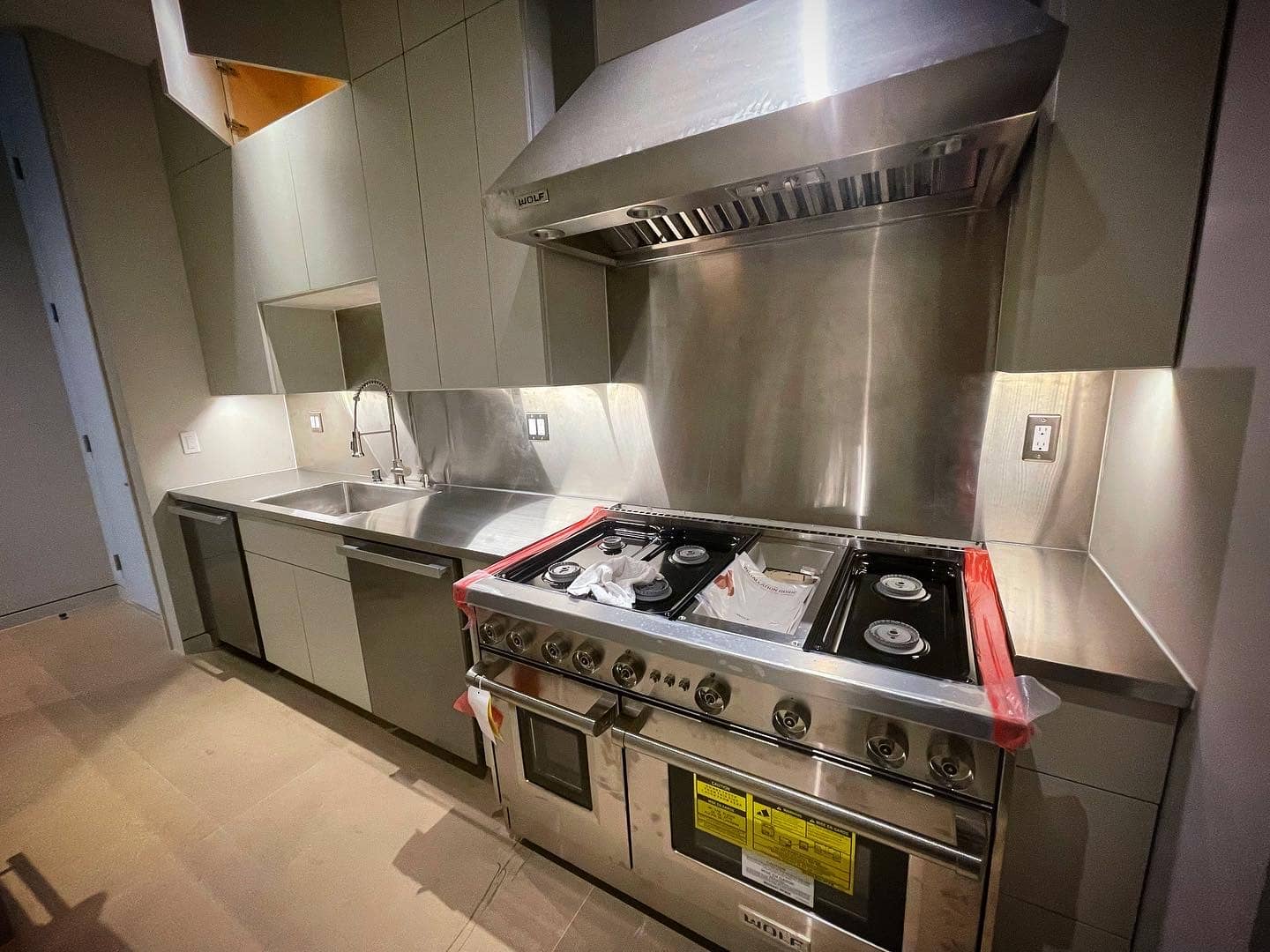
A "hand-finished" stainless panel can mean almost anything in this trade. It can mean one polisher running one orbital sander in straight lines until somebody decides the panel is done. It can mean a single pass at one grit followed by a marketing photo. It can also mean a real, repeatable technique that actually does what hand-finishing is supposed to do.
The technique we use is the third one. It's not exotic, but it's not common either. Here's what it actually is.
Start on the right canvas — 2B mill 304
Most architectural finishes begin on a stock #4 satin panel from a service center. The #4 has a parallel grain already laid in by a wide belt at the mill. Whatever you do on top of it is in conversation with that grain.
We start on 2B. That's the flat, low-gloss mill finish that comes off the cold-rolling line — no directional pattern, no pre-applied texture, no head start. It shows every handling mark and every contaminating fingerprint. That's the feature, not the flaw. A clean 2B panel gives the polisher a uniform substrate to write a new pattern onto.
If you start on a #4 and try to lay a non-directional finish on top, the original grain bleeds through under raking light. If you start on 2B, the only pattern on the surface is the one you're putting there.
One sander is a description. Two sanders is a technique.
Most hand-finished stainless is laid down with one orbital sander, one operator, one direction of motion at a time. The operator varies the direction by hand, but muscle memory takes over. A directional bias creeps in within ninety seconds. By the time the panel is "done," the pattern reads as roughly random — but under raking light, the bias shows up.
Two sanders, run simultaneously in opposing figure-eight loops, force actual randomness into the wrist mechanics. The operator can't accidentally bias the pattern because the two sanders are physically constrained to follow different paths. It's the mechanical equivalent of writing your name with both hands at once — it's harder, and the resulting pattern is more genuinely non-directional than anything one hand can produce.
That's the part of the technique you can see in a photo. The part that matters is what happens over time.
The finish builds with time, not with grit
In most polishing operations, the time-saving move is to climb the grit progression — start at 80, jump to 120, jump to 220, jump to 320, finish at 400. The faster you climb, the less time per grit. The faster the job is done.
Hand-finishing on the two-sander method doesn't allow that. The pattern density — what gives the surface its eventual depth and texture — is a function of how many minutes per square foot the sanders are on the surface at controlled pressure with controlled overlap. The grit progression matters, but the time per grit matters more.
A surface that gets the right grit progression but only half the dwell time looks under raking light like a finish that got rushed. The grain is still there. The depth isn't. The eye reads it as flat — slightly chaotic, but flat.
This is why hand-finishing can't be measured in grit numbers on a spec sheet. It can only be measured in minutes per square foot at each step. That's a different kind of spec sheet, and most shops don't write one.
Why the pattern hides scratches — no parallel reference
Every scratch on a polished surface is a microgroove. The eye locates it because the surrounding surface is directional — a hairline grain, a #4 brushed pattern, a swirl. The microgroove violates the pattern around it.
On a properly run two-sander figure-eight finish, there is no pattern around the scratch. The surface itself is a field of randomly-oriented microgrooves. A new scratch joins the field. The eye has no reference line to compare it against.
This is optical concealment, not metallurgical resistance. The scratch is still there. The substrate hasn't gotten harder. What's changed is the reader's ability to see the damage. Over the ten-year life of a bar top, optical concealment is what determines whether somebody calls you back to ask about year three.
The surface finish primer from Nickel Institute walks through the same principle from the metallurgical side: directional finishes are dressier and less forgiving; non-directional finishes are forgiving and harder to fake.
Where machine finishing wins — and where it loses
Machine finishing has a place. CNC sanders, belt grinders, and roll-marked finishes are appropriate for long, narrow stock — service-side counters, kick rails, undercounter panels. They're fast, consistent, and acceptable on surfaces nobody is going to photograph at 30° raking light.
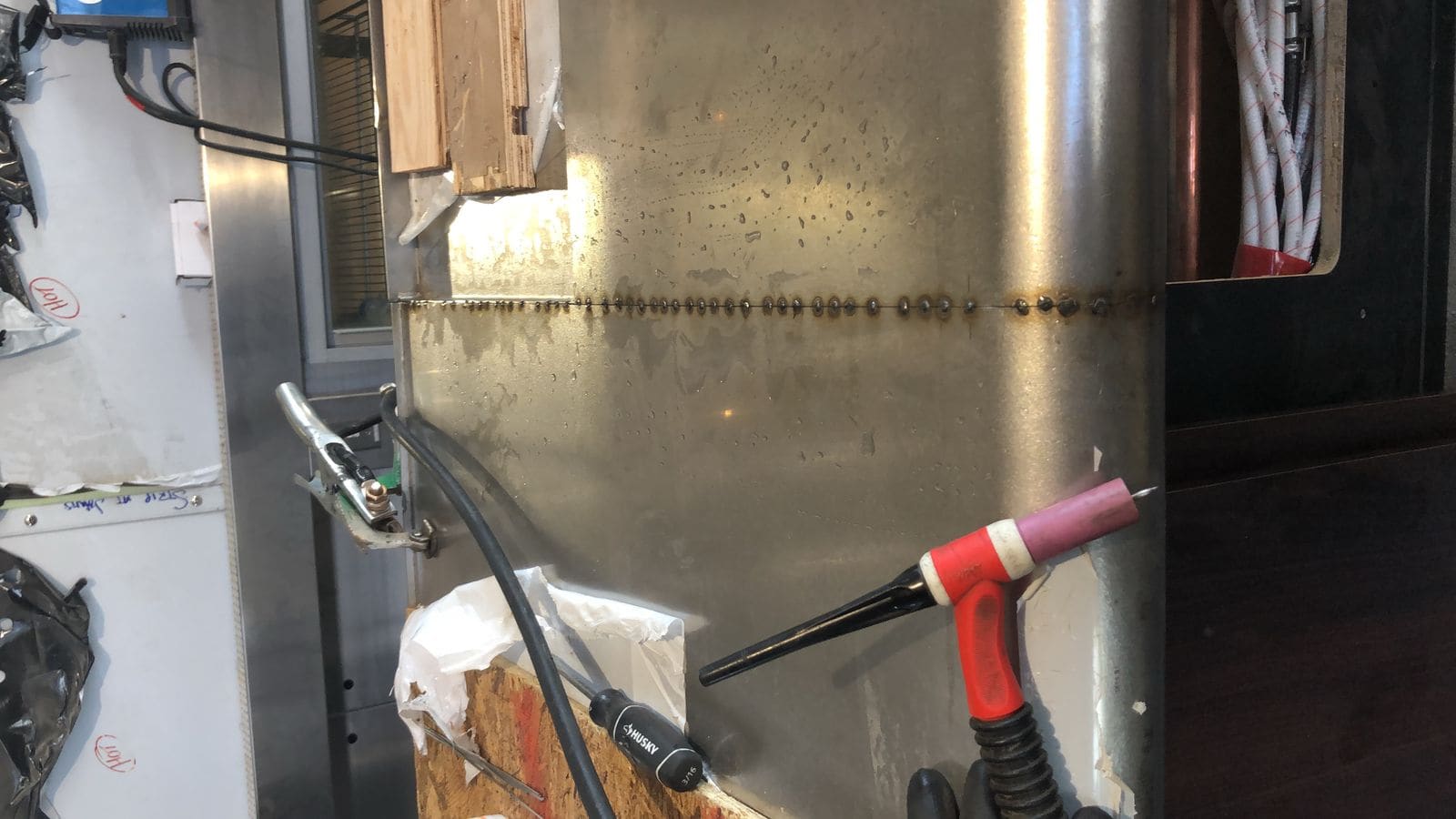
Where machine finishing loses is on anything that meets a corner, follows a curve, or runs into a weld bead. The machine pattern can't blend into the weld zone because the weld zone breaks the directional grain that the machine just laid down. The polisher has to come in by hand and freestyle the blend. The result reads as a patch.
Two-sander hand-finishing has no directional grain to break. The weld zone blends in because the surrounding field is already non-directional. The polisher isn't trying to match a pattern. They're continuing a pattern.
That's the reason every customer-side bar top with a 3" bullnose return — meaning every restaurant bar top in our practice — gets hand-finished. There's no other way to make the return blend cleanly.
The repair scenario — what hand-finishing actually buys you
Year five. A delivery cart clips a bar back. The panel has a scored gouge across an 8" zone.
A directional-finish panel in this scenario has to be repolished in the original direction with the original grit progression by a polisher who knows the recipe. If the original recipe wasn't documented, the polisher is guessing. The patch reads as a patch under raking light forever.
A two-sander figure-eight panel in this scenario gets re-run with the same two-sander figure-eight motion across the affected zone and a feathered border into the surrounding field. Because the surrounding field is non-directional, the patched zone integrates without showing a boundary. The polisher pulls the documented recipe from the file, runs it on the damaged section, re-passivates to ASTM A967, and the customer doesn't know it happened.
Hand-finishing buys you year-five repair invisibility. That's a real number on the warranty math, and it's the reason we hand-finish every customer-side surface even when machine finishing would be faster.
How to tell if a "hand-finished" surface actually is
Three questions to ask a fabricator who claims hand-finishing:
- "What substrate do you start on?" 2B is the right answer. #4 is fine for some applications; just not the same product.
- "How many minutes per square foot at the final grit?" If they don't know, they're not measuring it.
- "How would you repair a 4-inch gouge in this panel at year five?" A real hand-finisher pulls a documented recipe. A pretender freestyles.
Two of three is a real shop. One of three is somebody who needs to outsource the finishing on your project.
The bottom line
Hand-finishing stainless isn't a marketing claim. It's a wrist mechanic, a substrate choice, and a stopwatch. The two-sander figure-eight technique gives you a non-directional grain that survives a decade of service, blends into welds, and supports invisible repair at year five.
It costs more. It also costs less, by year five.
The two sanders we use on every M5 finish have logged enough hours that the rubber pads have been replaced eleven times. The motors are originals. The technique outlasts the equipment.
Everything on this blog comes off our shop floor and our job sites — 33 years of commercial stainless for In-N-Out, Yard House, SoFi Stadium, and 2,000+ builds across 35 states. If you're planning a project, we'll give you a straight answer on what it takes.