"Stainless doesn't rust." "If a magnet sticks, it's not real stainless." "All grades are food-safe." Three sentences that show up in customer calls weekly. All three are wrong, and the consequences of believing them range from cosmetic to legal.
Here are the eight stainless myths that most often produce bad spec decisions, and what to believe instead.
Myth 1 — "Stainless doesn't rust"
The marketing name is "stainless," not "rustproof." Stainless steel can and does rust under three specific conditions: surface contamination from carbon steel transfer (touching a non-stainless tool with the panel), chloride pitting from cleaning products or coastal air, and failure of the passive oxide layer when the passivation step is skipped during fabrication.
The orange spots on a stainless bar top are almost always one of those three. None of them are the steel's fault in the metallurgical sense — they're a fabrication or maintenance failure. They are, however, still rust.
The deeper walk-through is in Will Stainless Rust?. The short version: yes, and here's how to prevent it.
Myth 2 — "If a magnet sticks, it's not 304"
This is the most common in-field test for "real stainless," and it's diagnostic noise.
304 stainless is austenitic and nominally non-magnetic, but cold-working (cutting, bending, polishing) transforms some of the austenite to martensite, which is magnetic. A magnet stuck to a cold-formed corner of a 304 panel proves nothing — the corner is more magnetic than the panel face because the steel was deformed there.
430 stainless is ferritic and always strongly magnetic. So a magnet sticking can mean 430 or a cold-worked area of 304. The actual test for grade is the mill test report, not a kitchen magnet. The full mechanism is in the magnet test post.
Myth 3 — "All stainless is food-safe"
"Food-grade stainless" is a loose phrase. Real food-contact applications need to meet NSF/ANSI 2 for the construction itself (cleanable seams, smooth surfaces, accessible internal corners) and the steel grade has to be appropriate for the contact category.
304 is the standard for food-contact applications in the US. 316 is required where chloride exposure is high (marine, healthcare-adjacent). 430 is not appropriate for food-contact applications outside of certain low-acid, low-chloride contexts because of its pitting behavior. Specifying "stainless" without the grade and without NSF/ANSI 2 compliance documentation is not the same as specifying a food-safe product.
Myth 4 — "Mirror finish is the highest quality"
#8 mirror finish costs more than #4 satin. It also fails sooner in service. A mirror shows every fingerprint, every glass ring, every water spot, and every micro-scratch. On a customer-side surface that gets touched 1,000 times per shift, mirror finish telegraphs every contact within an hour.
Mirror has its place — accent panels, vertical surfaces with no service contact, certain architectural features. It is not the right finish for a bar top, a counter, or anything that takes glassware or skin contact. The right finish for those surfaces is a non-directional pattern that hides micro-scratches by removing parallel reference lines.
The finish primer covers this in detail: Hairline vs. Satin vs. Mirror.
Myth 5 — "Heavier gauge always wins"
14 ga (0.0747") is thicker and stiffer than 18 ga (0.0478"). It also weighs roughly 56% more per square foot. For a customer-side bar top, the weight is a feature — the "thud" of a glass on 14 ga is part of the bar's quality signature. For a kitchen prep counter, the weight is an installation problem and the marginal dent resistance over 16 ga isn't worth the additional cost.
Gauge selection is a per-application decision, not a "thicker is better" decision. The full breakdown by application is in Stainless Steel Gauge: 14 vs. 16 vs. 18.
Myth 6 — "Stainless doesn't scratch"
It scratches. The microgroove from a glass slide or a dragged jewelry stone shows up immediately. The metallurgy of the steel doesn't change with the finish; only the visibility of the scratch changes.
Hairline and #4 finishes have directional grain. A scratch that runs across the grain reads as a defect. Non-directional finishes (M5 Oracle Sand, swirl, vibration) have no grain to violate; scratches join the field and don't read as defects. This is optical concealment, not metallurgical resistance.
Anyone who sells you "scratch-proof stainless" is either selling a coating (which can fail and look worse than the steel underneath) or selling a sentence that isn't true.
Myth 7 — "Welding stainless is welding stainless"
There are four common processes used on stainless: TIG, MIG, stick, and resistance. They are not interchangeable in the context of restaurant fabrication.
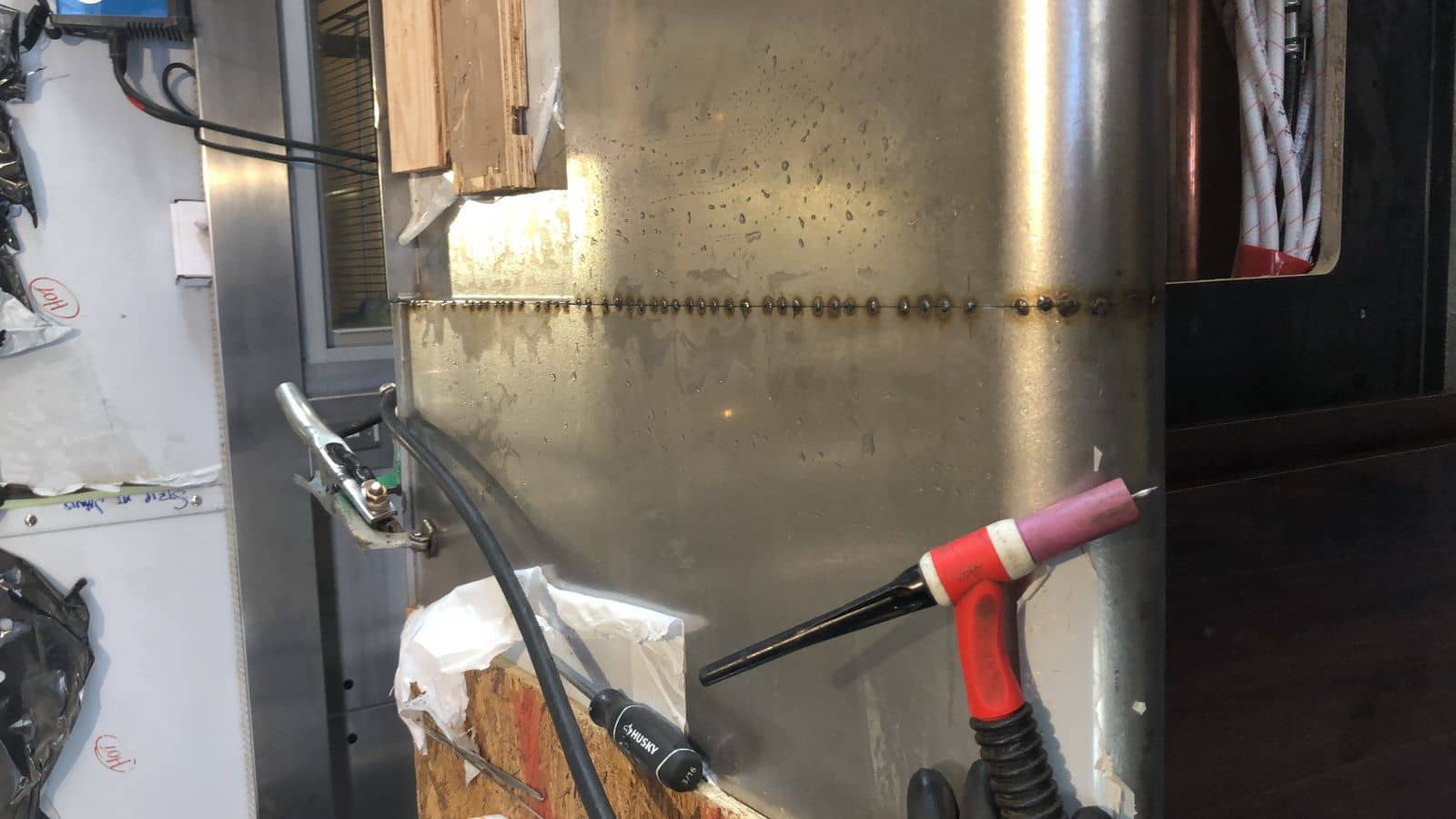
TIG with an argon back-purge is the standard for customer-side and food-contact applications. The back-purge displaces oxygen from the back side of the weld during the heat-affected window, preventing the chromium-depleted oxide layer (visible as a rainbow heat tint) that causes rust streaking in service. MIG produces a faster weld but without the same back-purge discipline, the rainbow tint is the norm. Stick and resistance welds are used in industrial applications but rarely show up in restaurant work.
If a bid is light on the weld spec, the most likely substitution is MIG without a back-purge. That savings is recovered by the operator at year three when the seams start to streak.
Myth 8 — "It's a commodity — any fab shop can make it"
Stainless is not a commodity. The substrate is consistent (most US 304 comes from a handful of mills), but everything that happens between the mill and the install is variable. Different shops use different finish recipes, different weld procedures, different passivation steps, and different install practices.
Two stainless bar tops fabricated by two different shops to the same one-line spec — "14 ga 304 with satin finish and 3" bullnose" — will look different on day one and age differently in service. The bid sheet doesn't capture the variance. The shop's documented procedures and the install crew's training do.
The conclusion isn't "pick the most expensive shop." It's "pick the shop whose procedures are documented enough that you can verify them."
Bottom line — myths cost more than knowledge
Each of the eight myths above has produced a bad spec decision in somebody's restaurant in the last 30 days. None of them require advanced metallurgy to correct. The fix is a short conversation with a fabricator who can answer the question without hedging.
If a bid in front of you is based on any of the eight myths, you have a decision to make about whether the bid is worth fighting through. Most of the time, the better move is to find a fabricator whose answers don't contain mythology in the first place.
The "real stainless" magnet on our shop fridge is a Buffalo Bills logo. Every visitor who tries to use it on a 304 panel has the same surprised face. The magnet works. The diagnostic doesn't.
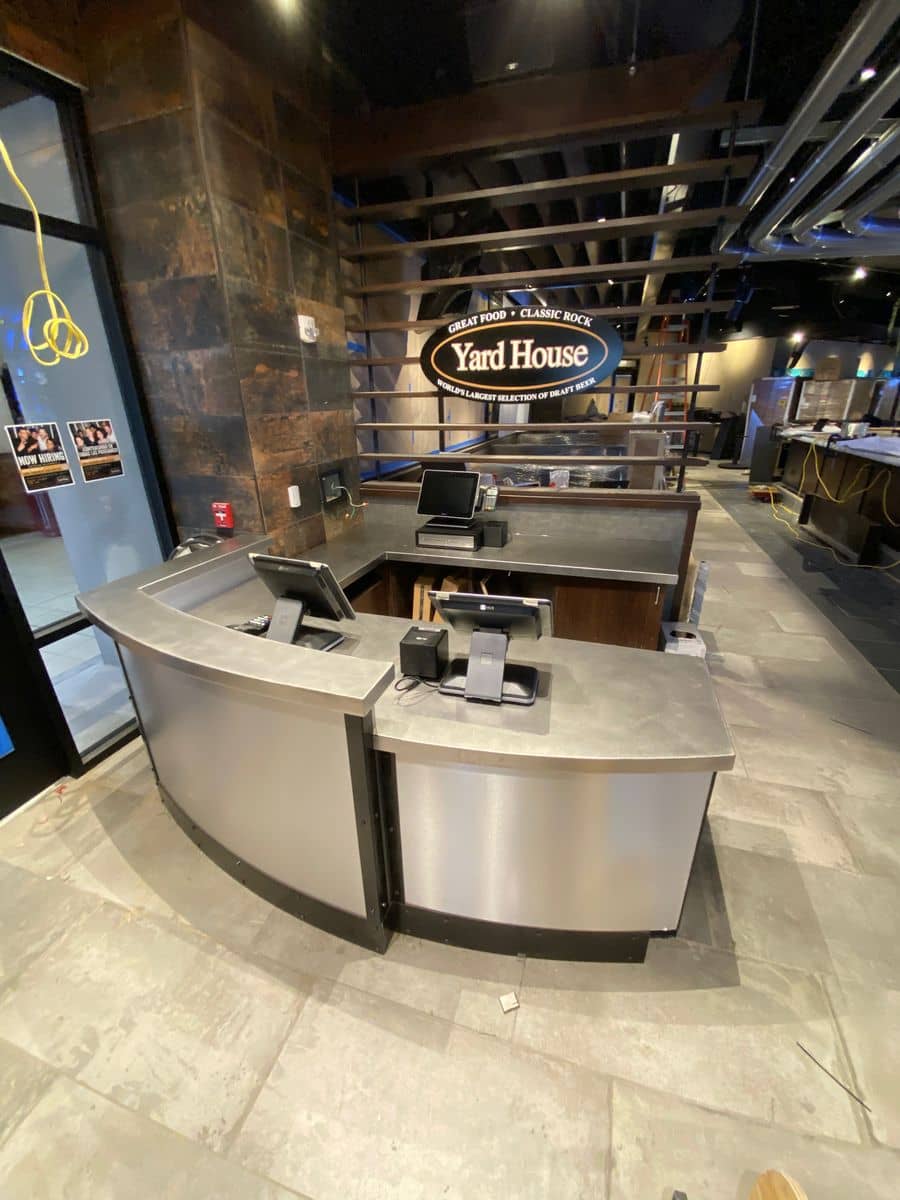
Everything on this blog comes off our shop floor and our job sites — 33 years of commercial stainless for In-N-Out, Yard House, SoFi Stadium, and 2,000+ builds across 35 states. If you're planning a project, we'll give you a straight answer on what it takes.