A stainless bar top is one of the few line items in a restaurant build-out that lasts longer than the lease. The ROI math reflects that — or it doesn't, depending on how the bid was written.
Most stainless bids get evaluated on price per square foot. That's the wrong number. The right number is cost per service year. The first one is what the bid sheet shows. The second one is what your accountant cares about in year ten.
The wrong ROI math (price per square foot)
A 24-square-foot bar top is bid at $750/sq ft by Fabricator A and $1,050/sq ft by Fabricator B. Operators read those two numbers and feel like they have a decision to make.
They don't. They have two different products labeled with similar words.
Price per square foot tells you how much the panel cost on the day it left the shop. It tells you nothing about what the panel will cost over its service life. If those two products have different service lives, the cheaper-per-square-foot product is not the cheaper product.
The right ROI math (cost per service year)
Cost per service year is the total cost of ownership divided by the realistic lifespan. Total cost of ownership includes:
- Initial fabrication and install
- Repair cost over the lifespan
- Downtime cost during repair or replacement
- End-of-life replacement (if it happens before the next renovation)
Run the math on the same 24 sq ft bar top:
| Fabricator A (low bid) | Fabricator B (mid-market) | |
|---|---|---|
| Initial cost | $18,000 | $25,200 |
| Realistic lifespan | 7 years | 20 years |
| Repair cost over lifespan | $4,500 | $1,200 |
| Replacement at year 7 | $19,500 | $0 |
| Total 20-year cost | $42,000 | $26,400 |
| Cost per service year | $2,100/yr | $1,320/yr |
The bid that was 40% cheaper on day one is 59% more expensive per service year.
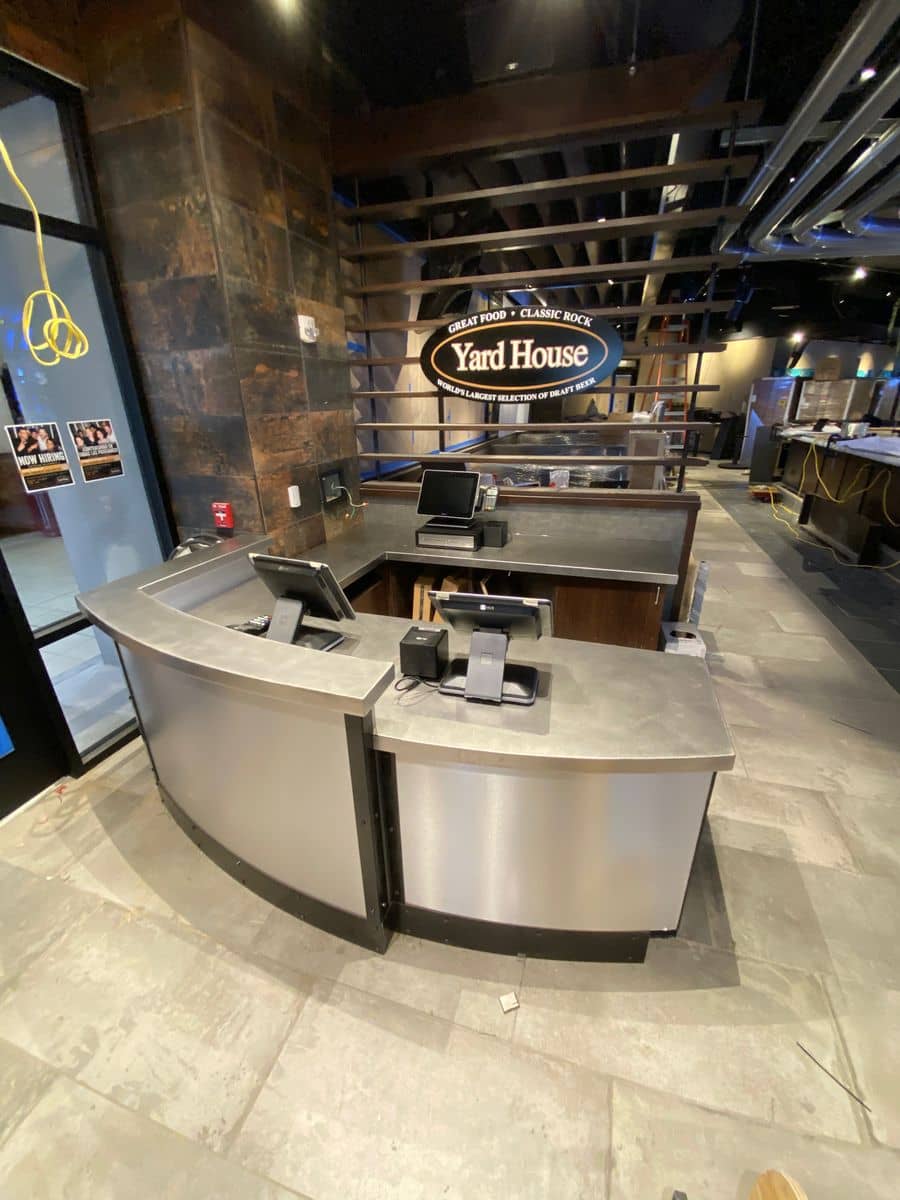
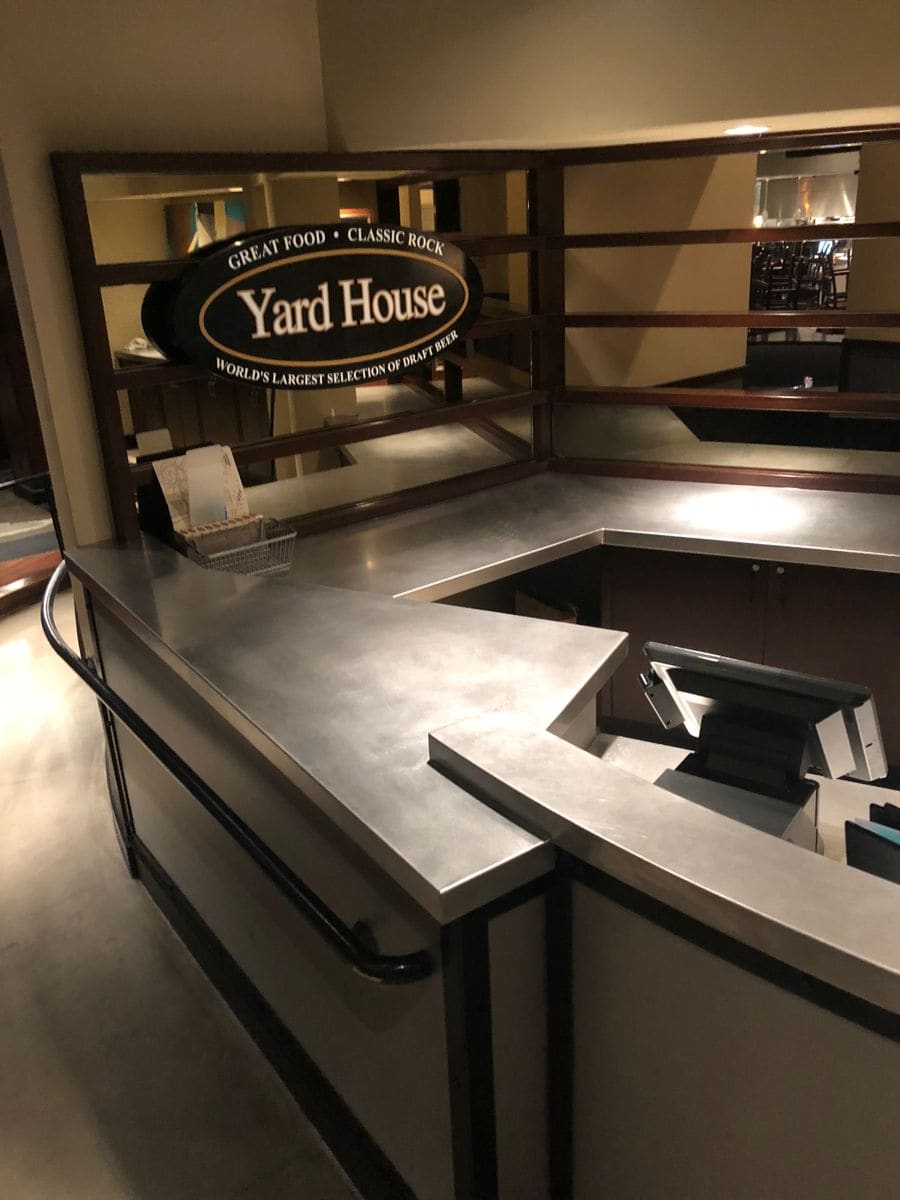
This is not theoretical. A national casual-dining chain has run essentially the same custom stainless bar top across 200+ locations for two decades [VERIFY: 20+ years at Yard House, location count]. The original install cost more than the cheap alternative. The replacement cost — across two decades, in 200 locations — has been zero.
Downtime is the cost line nobody puts on the bid
Every operator can model lost revenue per closure day. Bar service runs 40–60% of total revenue in many restaurant concepts. A closure to replace a failed bar top costs more than the bar top itself in three or four days.
A bar top failure is rarely a same-week fix. Material on the shelf, fabrication time, install scheduling, refinishing — a complete replacement is usually 2–4 weeks of either reduced service or full closure depending on the concept.
A bar top refinish — possible only if the original finish is repairable — is usually 1–2 days, often done overnight. That's the recipe-versus-description distinction from another angle: a repairable finish has near-zero downtime cost on year-five service work. An unrepairable finish has full-replacement downtime.
The downtime delta between the two bar tops in the table above isn't 13 years and one replacement. It's 13 years, one full closure for replacement, plus 3–4 freestyle refinishing visits with partial closure each.
The downtime cost is usually larger than the fabrication cost. It almost never appears on a bid.
Repair cost only exists if the finish is repairable
A finish is repairable only if the original recipe is documented and a trained operator can re-run it. That sentence sounds obvious. The reason most stainless finishes aren't repairable in service is that the original "recipe" was a freestyle pattern the original polisher laid down without writing it down.
This is the recipe-versus-description distinction that determines whether a damaged panel can be patched invisibly or has to be replaced. A documented recipe with a trained operator and a passivation procedure per ASTM A967 turns a year-five gouge into a 90-minute service call. An undocumented finish turns the same gouge into a panel replacement.
The 15–25% premium for a documented-recipe finish (the M5 Oracle Sand framing) is the cheapest insurance an operator buys on a 10-year service horizon.
A four-line worksheet you can run on any bid
For any custom stainless bid in front of you, calculate:
Line 1 — Initial cost. The bid total, including install and freight.
Line 2 — Realistic lifespan. Ask the fabricator: "Show me an install of yours from at least ten years ago that's still in service." If they can't, mark the lifespan at 7 years. If they can, mark it at 20.
Line 3 — Lifetime repair cost. Ask: "What's the documented finish recipe for this install?" If there isn't one, estimate 2–3 freestyle refinishing visits over the lifespan at $1,500 each. If there is, estimate one in-recipe touch-up at $400.
Line 4 — Downtime cost. Ask: "If a panel is damaged at year five, what's the realistic turnaround?" If the answer is "we'd schedule a replacement," estimate 2–4 weeks of reduced service revenue. If the answer is "we'd run the recipe on site," estimate one off-hours session at zero downtime cost.
Total cost of ownership = Line 1 + Line 3 + (Line 4 × revenue-per-day × closure days) + replacement at end of lifespan if it falls inside your planning horizon.
Divide by lifespan to get cost per service year. That's the number to compare across bids.
What to ask the low bidder
Three questions, in order:
- "Show me a 10-year-old install of yours that's still in service." Lifespan is the dominant variable in the ROI math. If they can't show it, the 7-year assumption is conservative — it might be 4.
- "What's documented in the file about the finish recipe?" If nothing is, the repair cost line is 3× the bid implies.
- "On day 30, what's the warranty path?" If the install was subbed, the warranty has a hole at the install seam. The 5-year reset cost shows up earlier than the lifespan number suggests.
If the answers are wrong on any of the three, the bid that looked 30% cheaper is structurally 50%+ more expensive over the same window.
Bottom line
Custom stainless is one of the cleanest ROI cases in restaurant construction. It's also one of the most often miscalculated because the right metric — cost per service year — isn't the metric on the bid sheet.
A documented-recipe install with an in-house install crew and a passivation step you can verify costs more on day one and less on year ten. The math is not subtle. The bid sheet just doesn't tell you that until you re-do the math yourself.
We'll run the worksheet on any bid you send us, including bids that aren't ours. That offer is genuine — sometimes the right call is one of the other fabricators, and we'll say so if we see it.
The first bar top our shop ever installed under our name is still in service in a restaurant in Pomona. The original fabricator is the same shop that's writing this post. The finish is on its third recipe re-run. The customer has never been closed for repair.
Everything on this blog comes off our shop floor and our job sites — 33 years of commercial stainless for In-N-Out, Yard House, SoFi Stadium, and 2,000+ builds across 35 states. If you're planning a project, we'll give you a straight answer on what it takes.