A 6-foot off-the-shelf stainless counter from a restaurant supply catalog costs about a third of what a custom-fabricated one costs. The catalog version is sized for the shop that made it. Yours probably isn't sized like that.
Where the off-the-shelf product saves money, and where it costs you that money back over the service life, is concentrated in four places: material spec, fit tolerance, finish, and install.
Off-the-shelf is a tolerance compromise
The most expensive 1/8" in a restaurant build-out is the gap between an off-the-shelf counter and the wall it's installed against. Catalog pieces ship in standard widths and lengths — usually 4', 6', 8', 10', 12'. Your bar isn't one of those numbers. The crew on the install pad shims, hacks, or accepts a visible seam.
Each option produces a result that ages badly:
- Shim solution: the bar is now sitting on a 3/8" piece of plywood somewhere. That plywood swells, rots, and shifts. The bar reads as out-of-level by month six.
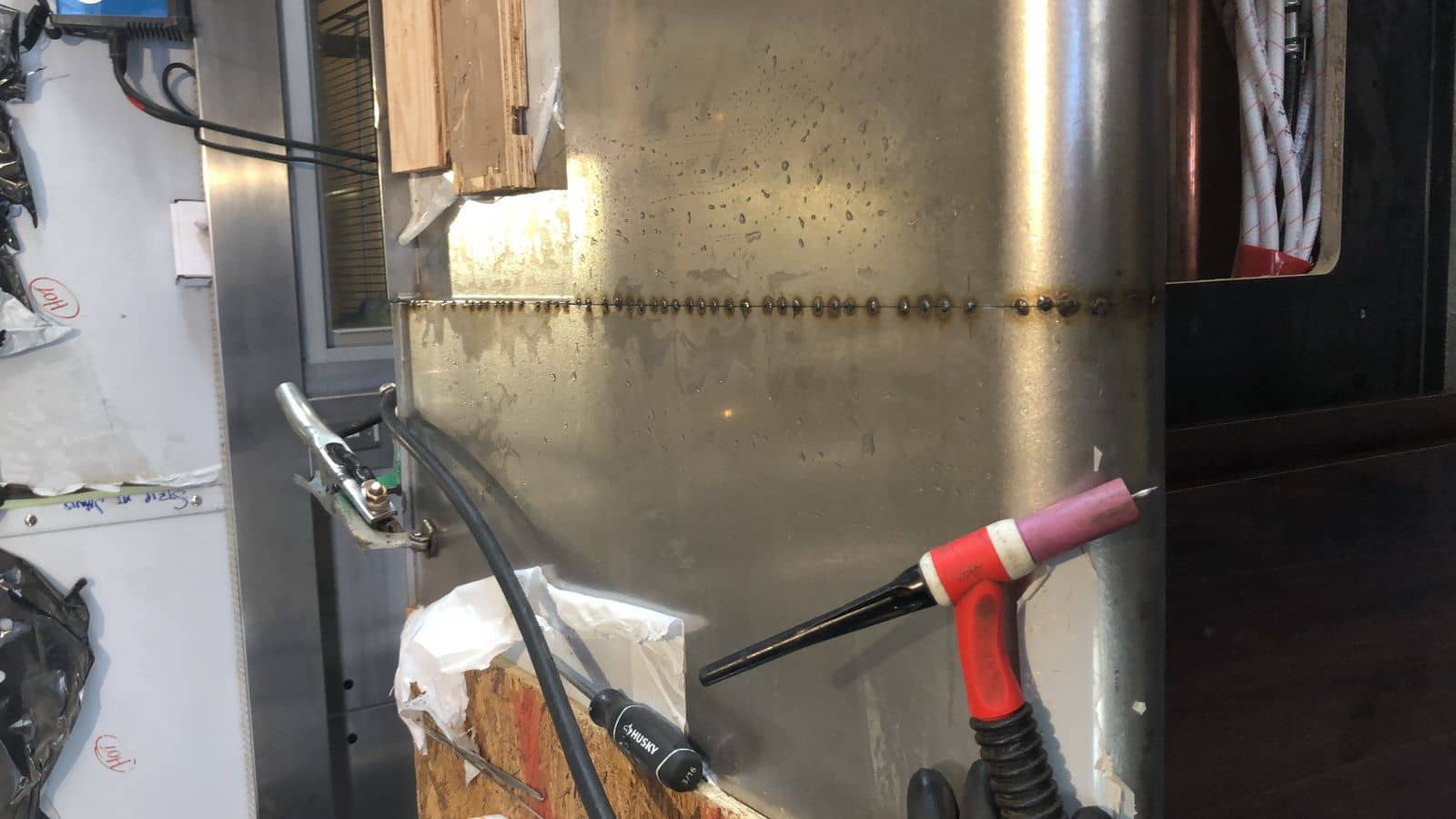
- Hack solution: the field crew cuts the catalog piece on site. Site cuts in stainless are almost never as clean as shop cuts, and the cut edge is rarely passivated. Within a year, the cut edge is showing surface rust.
- Accepted seam solution: the operator lives with a 1/8" gap between the counter and the wall. That gap is a cleaning problem (cleaning chemicals pool there, the floor team can't reach it, organic material grows), a structural problem (no rigid connection at the wall means the counter rocks under service load), and a visual problem (the gap is the first thing every customer's eye lands on).
Custom fabrication eliminates the tolerance problem because the piece is measured against the room, not against a catalog page. The fit is the spec, not the result.
Off-the-shelf almost never matches your finish
Stock catalog stainless is supplied in a #4 mill satin finish. The grain is parallel, machine-applied, and consistent at the catalog level. It's also wrong for a restaurant interior under raking light.
A #4 finish reads as dressy under overhead shop fluorescents. Under restaurant lighting — pendants and accent spots throwing light at low angles — the parallel grain pulls into harsh striping. A scratch that crosses the grain is screamingly visible. A new panel installed next to an existing panel almost always reads as a mismatch because the grain direction isn't perfectly aligned.
Restaurant-appropriate finishes are non-directional. They hide scratches because they remove the parallel reference lines a scratch would otherwise violate. Hand-finished recipes like M5 Oracle Sand do this by design. An off-the-shelf #4 doesn't.
The repair problem compounds it. A scratch on a non-directional hand-finished panel gets re-run with the documented recipe and disappears. A scratch on a #4 mill finish has to be repolished in the original direction by somebody who matches the grain — which is hard, requires shop access, and rarely produces an invisible patch.
Custom owns the install
Off-the-shelf pieces are delivered. Custom pieces are installed.
The distinction matters because a custom fabricator with an in-house install team is one accountable party for templating, fabricating, shipping, installing, finishing in the field, and warranting the work. Off-the-shelf pieces shift the install onto somebody else — the GC, a handyman, or a local sub — and the warranty becomes a finger-pointing problem if anything fails.
A real install includes a site survey before fabrication, a templating step that catches out-of-plumb walls and elevation drift, and a finishing pass on site under raking light to verify the install is consistent with the shop QC standard. Off-the-shelf pieces don't get any of those steps. The piece arrives in a crate; the crew on site does what they can with what's in the crate.
This is the structural difference between "delivered" and "installed." Both can produce a working bar top. Only one of them takes responsibility for whether the installed result matches the room.
The full walk-through of in-house install vs. subbed install is in a separate post. The short version: who installs your stainless decides who fixes a problem at year one and at year five.
A four-question test for "do we actually need custom"
Not every restaurant project needs custom stainless. Back-of-house prep counters, equipment fronts, ducting, and many service-side panels are fine in off-the-shelf product. The four questions that determine whether your project needs custom for a given surface:
- Will customers see this surface? If yes, the finish needs to be designed for restaurant lighting. Off-the-shelf #4 is wrong.
- Is the surface a standard catalog size? If no, off-the-shelf will produce gaps, hacks, or seams.
- Does the surface meet a wall, a corner, or an equipment integration? If yes, the tolerance demand is custom-only.
- Does the project have a 10+ year service horizon? If yes, the repair cost over the lifespan dwarfs the day-one cost delta. Custom amortizes; off-the-shelf doesn't.
Three or four "yes" answers means the surface should be custom. Two or fewer means off-the-shelf is appropriate and the spend should go elsewhere.
This is the question we'd want every first-time operator to be able to ask themselves before getting a bid. The ones who skip the test usually over-buy custom on back-of-house surfaces and under-buy custom on the bar top — exactly the wrong way around.
When off-the-shelf is fine — and when it costs you
Off-the-shelf is fine for:
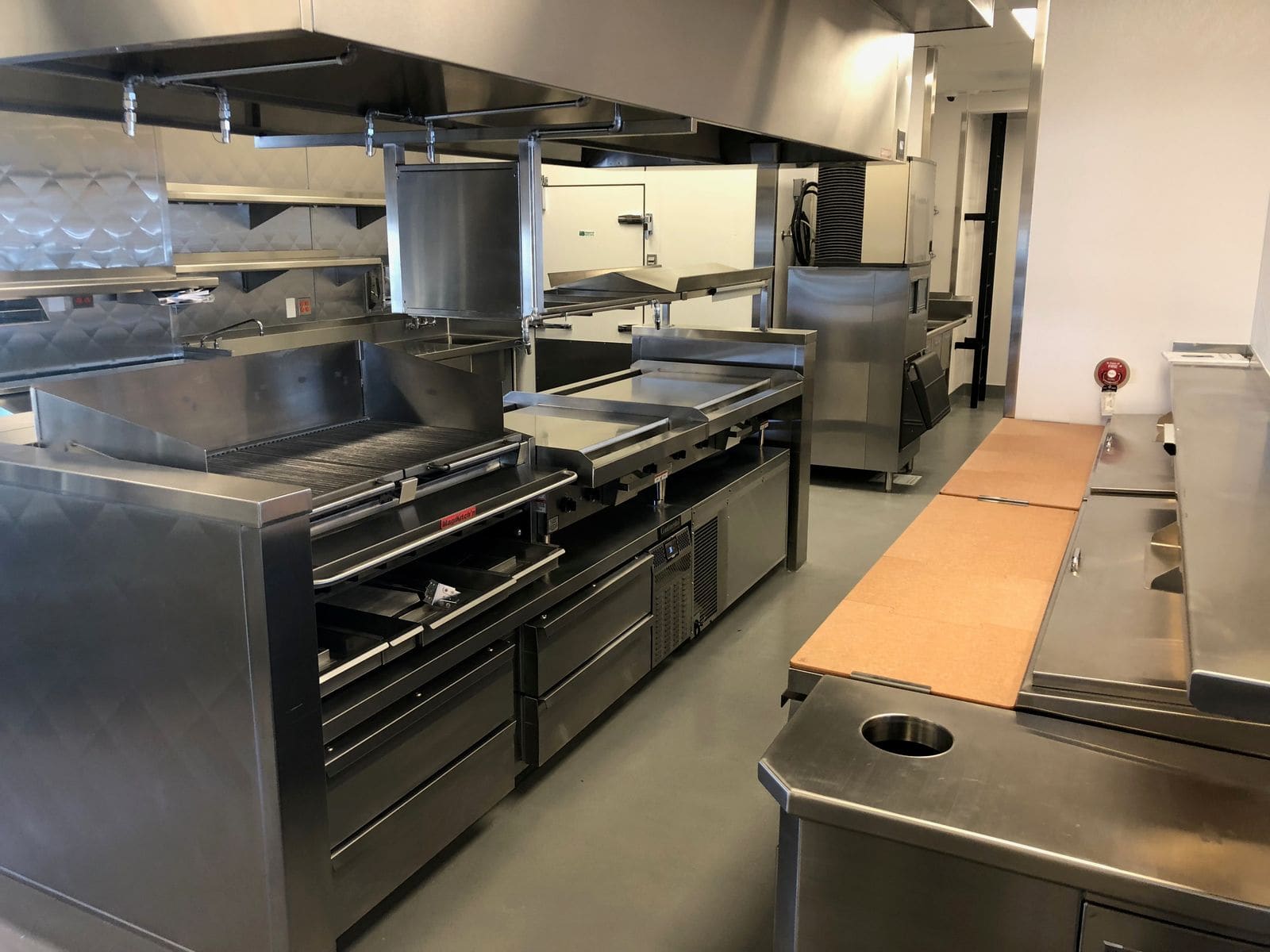
- Back-of-house prep tops away from customer line of sight
- Equipment fronts in standard widths
- Ducting, splash panels, and other non-touch surfaces
- Time-pressured emergencies where a 7-day fabrication clock isn't an option
Off-the-shelf costs you on:
- Customer-side bar tops
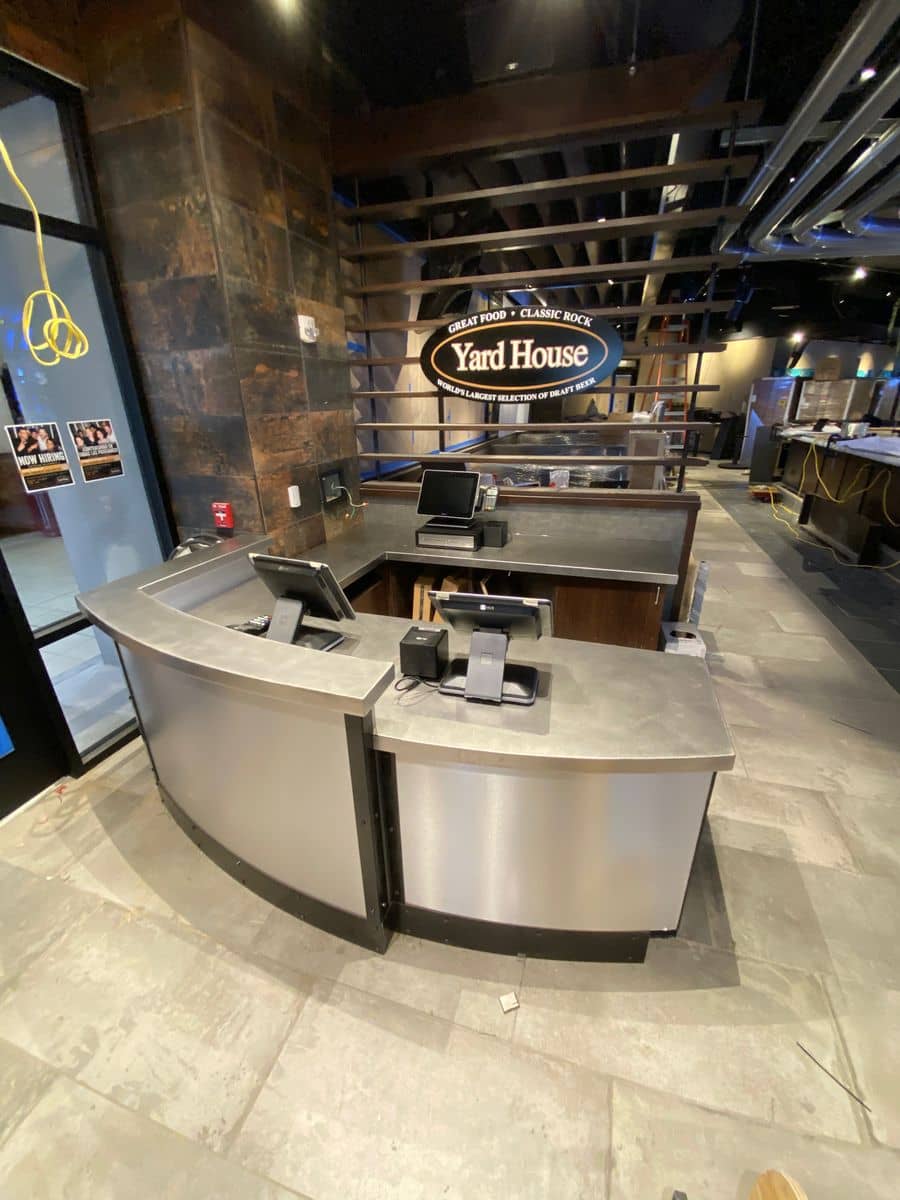
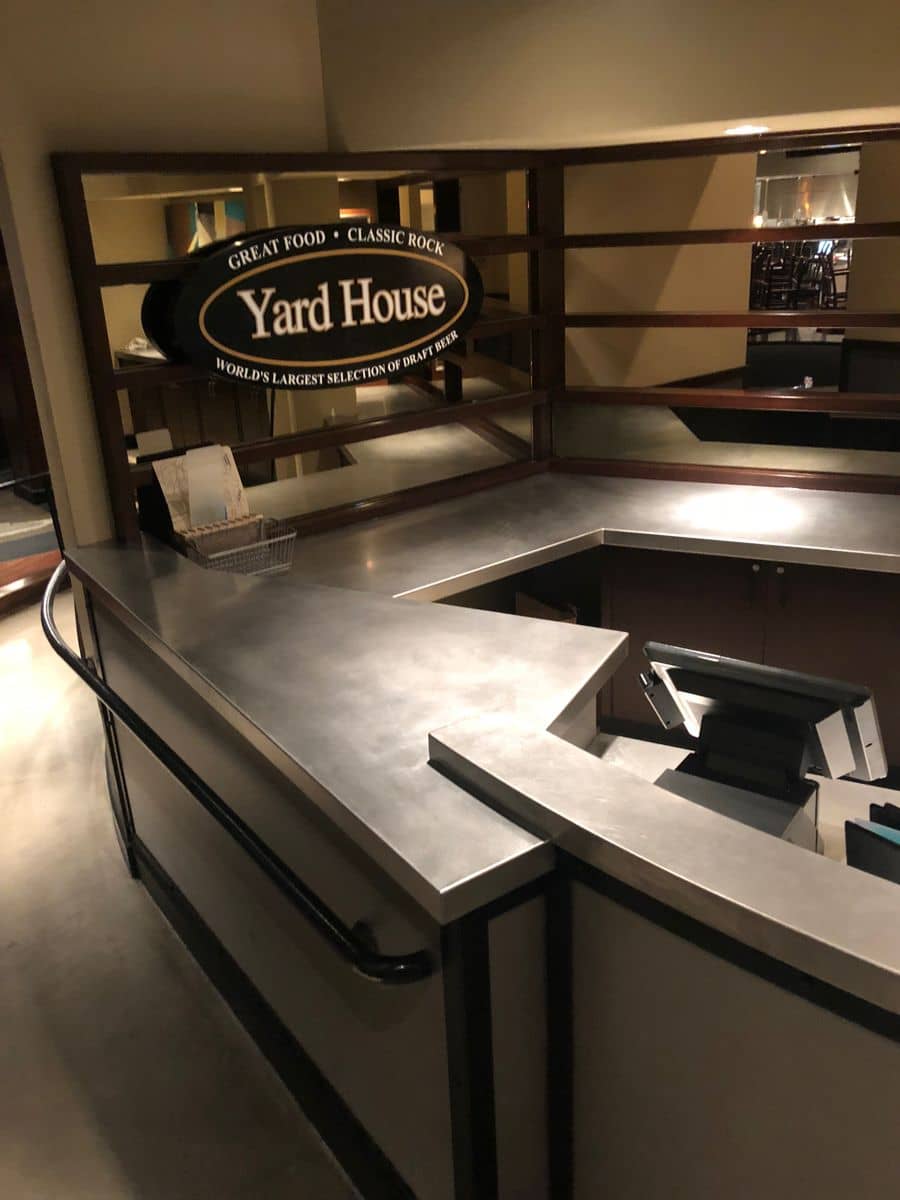
- Service-side bars with curves or non-standard geometry
- Any surface that meets a wall, a column, or an existing finish
- POS surrounds, hostess stands, or other front-of-house fixtures
- Any project where the lease horizon exceeds the off-the-shelf service life (which is most of them)
The decision isn't "always custom." It's "custom where it matters, off-the-shelf where it doesn't." Most restaurant projects need the split.
Bottom line
Custom stainless beats off-the-shelf for the same reason a tailored jacket beats a rack one: the dimensions, the materials, the finishing, and the seams are spec'd to the wearer instead of to a population average. The catalog version is a good price for an average customer. You're not an average customer.
If you're staring at a price gap between off-the-shelf and custom and trying to decide, run the four-question test on each surface. The surfaces that come back "custom" are the ones where the day-one premium becomes a year-five savings. The surfaces that come back "off-the-shelf" are the ones where the catalog product is genuinely the right answer.
We'll run the test on your scope if you send us a floor plan. Even if it points to off-the-shelf for half the surfaces, the test still serves you — you just spent less than you would have on a vague "stainless package."
The first thing our drafter draws on every new project is the wall line — not the bar line. The bar gets sized to the wall. The wall doesn't get hacked to take the bar.
Everything on this blog comes off our shop floor and our job sites — 33 years of commercial stainless for In-N-Out, Yard House, SoFi Stadium, and 2,000+ builds across 35 states. If you're planning a project, we'll give you a straight answer on what it takes.